
Which kit should I choose for direct dash cam hardwiring?
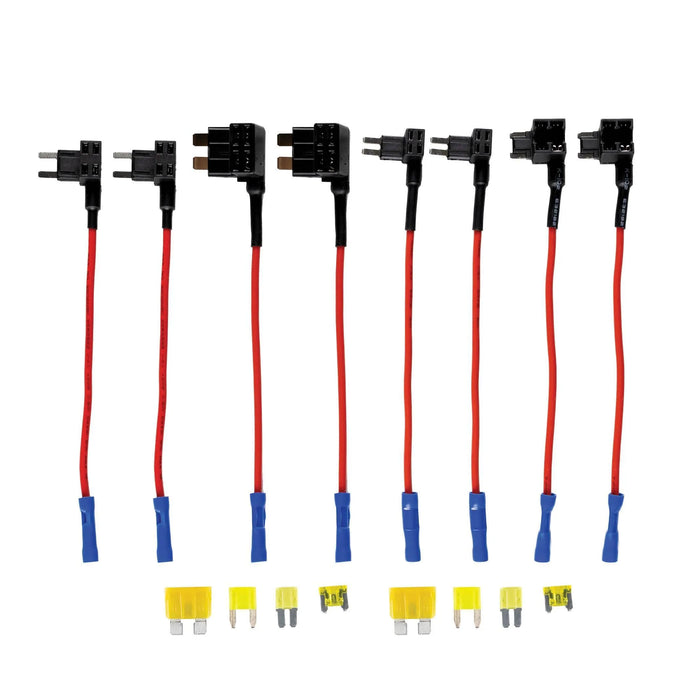
A three-wire kit normally needs constant and switched fuse connections, so choose two of each standard style if those styles fit your vehicle. Confirm the camera kit’s requirements first; Micro3 uses the separate option.
Why is the battery-pack option one of each?
Many battery packs need one switched charging circuit. The kit gives you four common styles to choose from, not four connections that must all be installed. Follow your battery’s actual charging instructions.
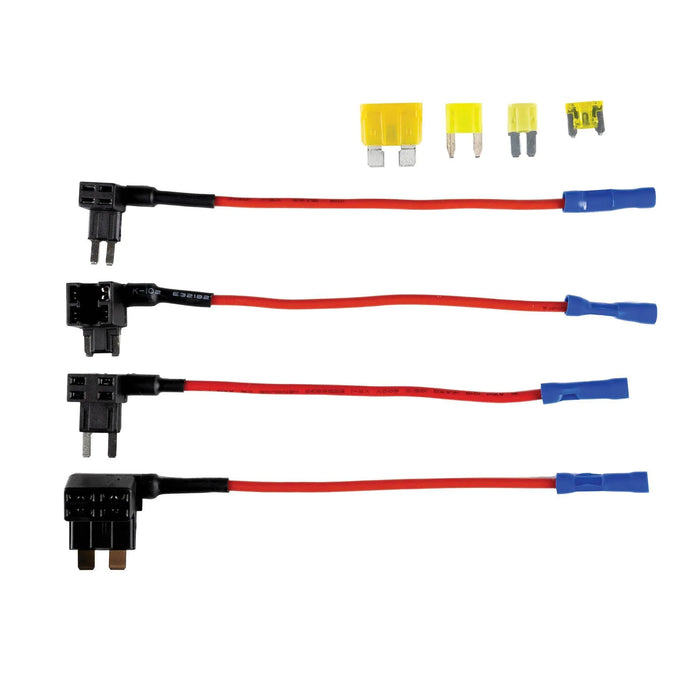
Are Micro2 and Micro3 interchangeable?
No. They are different physical fuse types. Micro3 is sold separately as a pair and is not included in the standard one-of-each or two-of-each kits.
Should I always install the supplied 20A fuse?
No. Use the rating required for the accessory branch, wiring and tap. A smaller dash cam load may call for a lower-rated fuse. Keep the original vehicle circuit at its specified rating; do not increase it to match an included fuse.
Does a fuse tap replace a hardwire kit?
No. It connects an appropriate power lead to the fuse panel. It does not regulate power, detect ignition by itself or provide a low-voltage cutoff.
Do red and yellow wires mean the same thing on every brand?
No. Use the wire labels and exact hardwire-kit instructions to identify constant power, switched power and ground. Confirm circuit behavior with a suitable tester before connecting.
Does this include installation tools?
No. This listing is the fuse-tap kit. The Essential Install Package includes taps plus a circuit tester, trim tool, zip ties and decals.
Can I use any spare fuse slot?
No. A spare-looking slot may have no suitable supply or may not be appropriate for an accessory. Confirm the vehicle diagram, circuit behavior, available capacity and tap orientation. Use an installer when those checks are uncertain.